STEALTHVPN / USE-CASE RESEARCH
What does a VPN add on public Wi-Fi?
Understand the extra network privacy without pretending HTTPS does nothing.

Research checked 2026-11-06 · source-based guide
A VPN can reduce local-network and ISP visibility for traffic actually routed through its tunnel. You are shifting part of that trust to the VPN operator.
Provide an encrypted path to your chosen tunnel endpoint.
Make a malicious website safe or stop an account login identifying you.
What you want hidden, who operates the endpoint and what remains outside the tunnel.
HTTPS already protects much of the content
The FTC notes that most websites now encrypt traffic and public Wi-Fi is usually safe as a result. Keep HTTPS and device updates in view when judging a VPN’s extra value. An encrypted connection does not, by itself, establish that a website is trustworthy.
The additional privacy layer
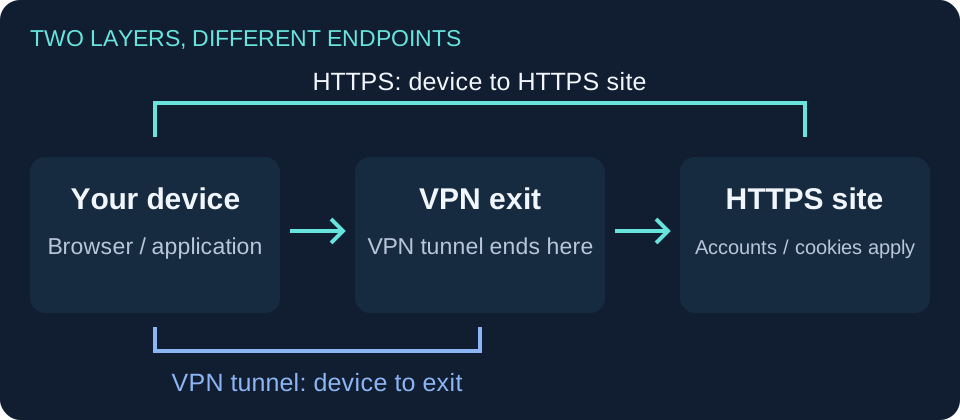
Conceptual path for traffic routed through a VPN to an HTTPS site. HTTPS and the VPN tunnel have different endpoints. Accounts and cookies still apply. This is not a tested configuration; follow the guide’s source and setup limits.
A properly configured tunnel can shield routed destination information from a local network or ISP, while those observers may still see a VPN connection and its timing. The exit operator gains network visibility; HTTPS remains important beyond that endpoint. Logins, cookies and other identifiers can still connect browsing to you.
Source: EFF · choosing a VPN and understanding its limits (opens in a new tab)
Turn the threat model into a checklist
These are setup questions to verify, not features we have tested for each service. A phone app, browser extension and router installation can cover different traffic.
- Confirm which apps and DNS requests use the tunnel.
- Understand what happens if the connection drops or changes network.
- Keep the VPN app, browser and operating system current.
- Inspect the operator, retained data, audit scope and disclosure history.
- Use the employer-approved connection for company resources.
Know when another tool addresses the concern
If the problem is reused passwords, browser trackers or a publicly listed address, a different privacy tool may address it more directly. A VPN is a network path choice, not a replacement for account security or personal-data removal.
Research state
This guide synthesizes published consumer/privacy guidance. StealthVPN has not performed Wi-Fi attack simulations, DNS leak tests or kill-switch tests on the listed services.
- 01
Your device
HTTPS protects content on the way to an HTTPS site.
- 02
VPN endpoint
A tunnel hides destinations from the local network; trust shifts to the VPN.
- 03
Website
The site still sees your account, cookies and the VPN exit.
Simplified HTTPS-through-VPN path. A VPN does not remove account identifiers or make an unsafe website trustworthy.
Sources and dates
- Consumer guidanceFTC · public Wi-Fi and HTTPS (opens in a new tab)Checked 2026-11-06 · source publication date not captured
- Privacy guidanceEFF · choosing a VPN and understanding its limits (opens in a new tab)Checked 2026-11-06 · source document/review date 2026-07-28
A source check is not a purchase, playback, deployment or security test. We do not infer account-enforcement rates or guaranteed savings from service rules. How our comparisons use evidence